What Do Solange Knowles (Beyoncé’s sister) And you have in common?

What Do Solange Knowles (Beyoncé’s sister), PMDD, Perimenopause, Sjögren’s, hEDS, POTS and MCAS Have in Common?

When Solange Knowles spoke publicly about having Mast Cell Activation Syndrome, Postural Orthostatic Tachycardia Syndrome and Sjögren's syndrome, many women quietly recognised themselves in the story.
Not necessarily the diagnosis itself.
But the pattern.
The years of symptoms that do not fit neatly into one box.
The feeling that something deeper is going on.
The frustration of being told “everything is normal” when clearly it is not.
I have been reflecting a lot lately on my role and the kind of women I currently see.
Many of the women who come to see me have already started HRT with their GP. Sometimes the estrogen has helped. The flushes are better. The sleep may be slightly improved. The periods may be more manageable.
But they still do not feel well.
They are still scoring highly on symptom questionnaires.
Still exhausted.
Still anxious.
Still inflamed.
Still overwhelmed.
Still feeling like they are not themselves.
And often they feel confused because they expected a miracle.
Their friend went on HRT and felt amazing within weeks.
They expected the same outcome.
But women are not all walking the same pathway.
Some women have underlying drivers that have not yet been recognised.
I increasingly see women with:
severe PMDD
ADHD, diagnosed or undiagnosed
autism traits
complex PTSD
nervous system dysregulation
hypermobility
chronic inflammation
histamine intolerance
mast cell activation patterns
autoimmune disease
chronic fatigue symptoms
persistent pain syndromes
I see younger women struggling with symptoms that are being dismissed because they are “too young” for hormones to be considered relevant.
I see women with vulval conditions such as lichen sclerosus not responding properly to conventional management, and when we step back and look at the whole person rather than only one body part, the picture often becomes clearer.
Sometimes estrogen deficiency is only part of the story.
Sometimes fluctuating estrogen is aggravating histamine pathways.
Sometimes nervous system hypervigilance from unresolved trauma is amplifying symptoms.
Sometimes poor sleep, cortisol dysregulation and inflammation are driving the picture.
Sometimes the body has been surviving for years in a constant state of physiological stress.
What gives me satisfaction is not simply prescribing hormones.
The joy comes from connecting the dots for women.
The moment when a woman says:
“Finally I feel seen.”
“Finally somebody listened.”
“Finally somebody explained why my body feels like this.”
That matters.
Some women improve very quickly.
Others improve slowly and steadily.
But many improve once the correct drivers are identified.
So my advice to women is this.
If you are battling symptoms, please do not wear suffering like a badge of honour.
You do not get a trophy at the end for enduring exhaustion, insomnia, anxiety, pain or burnout silently.
Many women have been conditioned to believe that constantly caring for everybody else while neglecting themselves is somehow noble.
But we did not come here only to survive.
We came here to live well, to love well, and to serve well.
And you cannot pour from an empty vessel forever.
I often say to women what I have had to say to myself:
you have to put on your own oxygen mask first.
Your first responsibility is to stabilise your own physical health, mental health and spiritual health so that you can become a more balanced human being.
If you have unresolved trauma, do not be afraid of therapy.
But find good therapy.
Therapy that helps you progress.
Therapy that helps you understand yourself and eventually stand stronger on your own feet.
The goal is not lifelong dependence.
The goal is healing, insight, growth and freedom.
Many people who later help others do so because they have walked through difficulty themselves.
I have a patient who once struggled with substance abuse. Today she helps other women in prisons and women struggling with addiction because she understands suffering from the inside.
Your story matters.
Your pain does not have to become your identity forever, but it can become part of your wisdom.
Many people who change lives are not people who had perfect lives.
They are people who learned, healed, adapted and then reached back to help others.
So if you are struggling with symptoms, do not ignore them.
Do not minimise them.
Do not assume you simply have to tolerate poor sleep, anxiety, rage, fatigue, pain or emotional overwhelm forever.
Ask questions.
Become curious about your body.
Find people who are willing to look at the whole picture.
And most importantly, live your life.
Live it well.
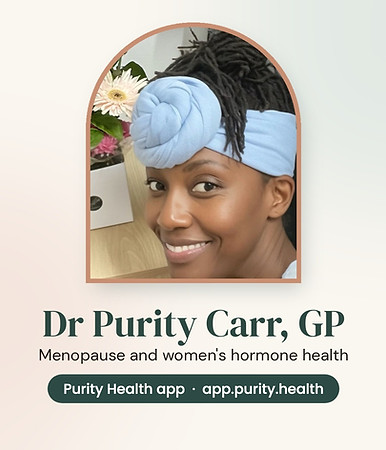
By Dr Purity Carr
MCAS/Histamine and Menopause Doctor


Comments